

5 Reasons Bauhaus Is the Best Alternative to Strip Nightclubs

5 Reasons Bauhaus Is the Best Alternative to Strip Nightclubs

Las Vegas has two nightlife scenes and most visitors only experience one of them. The Strip version is everywhere — visible, marketed, impossible to miss. The other Las Vegas nightlife operates on entirely different terms, a few miles away in downtown, and it’s the one that serious music lovers choose every time they’re given the option.

Here are five concrete reasons why Bauhaus Las Vegas is the best non-strip nightclub Las Vegas has to offer — and why once you’ve experienced the difference, going back to the Strip formula feels like a significant downgrade.

Reason 1: The Music Is the Actual Product

Walk into a Strip club and the music is background. It fills the room while the real products — bottle service, VIP tables, celebrity appearances — get sold. The DJ exists to maintain energy levels while people drink and pose. The musical content is interchangeable. Nobody in the room would notice if you swapped the DJ for a different one playing the same genre.

At Bauhaus, the DJ is why everyone in the room showed up. The lineup is curated around artistic integrity — underground house and techno artists who play three to five hour sets because the music requires it. The crowd researched who was playing before buying a ticket. Read more about why true techno fans choose Bauhaus over mainstream Vegas clubs to understand what this difference looks and feels like in practice.

As Resident Advisor — the definitive publication in underground club culture — has consistently documented, the distinction between music-as-product and music-as-backdrop is the most fundamental dividing line in nightlife. Bauhaus sits firmly on the right side of it.

Reason 2: The Sound System Is in a Different League

Strip clubs invest in production spectacle: LED walls the size of buildings, elaborate lighting rigs, video content designed to fill giant rooms with visual noise. The sound system is treated as infrastructure rather than the centrepiece. Bauhaus invested the other way. The Danley sound system at Bauhaus was chosen specifically because underground electronic music requires a quality of sub-bass reproduction and spatial coherence that most club systems can’t deliver.

The result is that music at Bauhaus sounds and feels completely different from music at a Strip club. The bass has definition rather than just weight. The stereo imaging is precise. The high frequencies are crisp without fatigue over a five-hour night. This isn’t an abstract technical distinction — it changes the physical experience of being in the room.

Danley Sound Labs is trusted by NFL stadiums, major concert halls, and the world’s most serious audio environments. The choice to put this system in an underground club in downtown Las Vegas is a statement about what the venue prioritises.

Reason 3: The Sets Are Actually Long

The typical Strip DJ set runs 45 to 90 minutes. An artist arrives, plays their slot, collects their fee, and leaves. The night is segmented into discrete branded appearances that reset the energy every hour. The cumulative build — the thing that makes a genuinely great night different from a good one — is impossible in this format.
Bauhaus headliners play for three, four, sometimes five hours or more. This isn’t just a scheduling choice. It’s what underground electronic music requires. The tension that builds across two hours of a set, the risks a DJ takes in the fourth hour when they know the room inside out, the peak that arrives because it’s been earned — none of this is possible in 90 minutes.

Boiler Room’s archive of live underground sets demonstrates this exactly — the most celebrated performances are all long-form sets where the DJ and the crowd build something together across hours, not across a single abbreviated appearance.

Reason 4: The Crowd Is There for the Same Reason You Are

Strip clubs attract a broad, tourist-heavy crowd assembled from the overflow of Las Vegas’s general visitor traffic. Many people in the room chose the venue based on its Strip address or its name recognition, not based on who was playing or what kind of music would be on. The crowd is diverse in its intentions and limited in its collective commitment to the music.
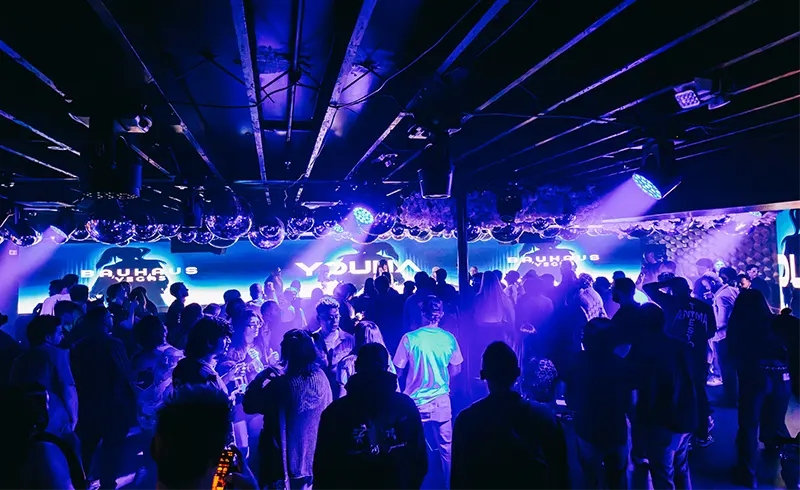
The crowd at Bauhaus is self-selected around the music. People drove or flew to Las Vegas with the Bauhaus lineup in mind. They’re familiar with the genre. They’re prepared for a long night. They’re not there to be seen or to document their evening — they’re there to dance. This changes the atmosphere in the room in ways that no amount of production can manufacture.

This is the collective intentionality that underground vs. mainstream clubs in Las Vegas comes down to — a room full of people with aligned reasons for being there creates a fundamentally different experience.

Reason 5: The Night Actually Runs Until Morning

Most Strip clubs close at 4am. The night ends by administrative decision while plenty of people in the room are still present and still willing. The after-hours experience — the part of the night when the casual crowd has gone and the room belongs to the committed — doesn’t exist in the Strip club model.

Bauhaus runs until 6am or beyond on weekends. The peak hours — the time when the DJ is in their fourth hour and the floor has never been more focused — happen consistently between 2 and 4am, in the hours after most Strip clubs have already closed their doors. Read about what makes Bauhaus Las Vegas an after-hours destination to understand what this extended format actually delivers.

Ready to experience the alternative? Book your tickets at Bauhaus Las Vegas here.

Facebook
Twitter
LinkedIn
WhatsApp

Frequently asked questions

What makes Bauhaus Las Vegas different from Strip nightclubs?
Bauhaus prioritises music over spectacle — a Danley sound system built for underground electronic music, DJ sets running 3–5 hours, a curated lineup of house and techno artists, and events running until 6am. Strip clubs offer production and celebrity appearances. Bauhaus offers a genuine music experience.
Yes — downtown Las Vegas is a 10–15 minute rideshare from most Strip hotels. Rideshare is recommended both ways for a night running until 6am.
Not at all. Come with an open mind, comfortable shoes, and the willingness to let the music build at its own pace. The underground community is welcoming to anyone genuinely there for the experience.
Bauhaus general admission is typically more accessible than Strip club entry, and VIP packages start at more competitive minimums than most Strip venues. The value-per-experience ratio strongly favours Bauhaus for music lovers.