

The Evolution of DJ Technology: From Vinyl to Digital and Beyond

The Evolution of DJ Technology: From Vinyl to Digital and Beyond

The DJ booth has always been the heartbeat of the dance floor, but the gear inside it? That’s changed completely. DJ technology history is really the story of how music culture itself evolved, one innovation at a time. From needle drops on vinyl to touchscreens and stems, the journey is as wild as a peak-hour techno set. Let’s break it all down.

Where It All Started: The Vinyl Era

The Turntable Takes Center Stage

Before digital anything, there was the record. DJs in the 1970s were the original tastemakers, hauling crates of vinyl to parties, block events, and underground clubs. The turntable wasn’t just a playback tool; in the right hands, it became an instrument.
Two turntables and a mixer. That was the rig. Simple, mechanical, and raw.
Hip-hop DJs like DJ Kool Herc pioneered the “breakbeat” technique, isolating the drum break of a record and looping it manually by switching between two copies of the same track. Meanwhile, disco and early house DJs in Chicago and New York were using vinyl to build extended sets that kept dancers locked in for hours.

Key innovation: The pitch control (or “strobe” slider) allowed DJs to manually sync tempos, the first form of beatmatching.

Why Vinyl Still Matters

Even today, vinyl holds serious weight in underground culture. There’s a tactile feedback, the warmth of analog sound, the ritual of flipping a record that digital tools have never fully replicated. Many of the world’s top techno and house DJs still carry records alongside USB sticks.

The Mixer Revolution: Crossfaders and Creative Control

From Utility to Artistry

The DJ mixer evolved right alongside the turntable. Early mixers were basic: a volume knob and a way to blend two channels. Then came the crossfader, and everything changed.

The crossfader gave DJs the ability to cut, scratch, and blend with precision. It turned mixing into performance. By the late 1980s and early 1990s, scratch DJs were treating the mixer like a musical instrument in its own right.

Key mixer milestones:

The CD Revolution: Enter the CDJ

Turntables to CDJs: A Seismic Shift

By the mid-1990s, a new format entered the booth: the CD. Pioneer released the CDJ-500 in 1994, and the game changed overnight. The turntables to CDJs transition wasn’t just about format; it was about workflow. DJs could carry hundreds of tracks on a single CD wallet instead of lugging 100-pound crates.

But the early CDJs had limitations. They lacked jog wheel sensitivity, couldn’t pitch-bend naturally, and purists rejected them hard. That resistance didn’t last long.

The Pioneer CDJ-1000: A Game-Changer

When Pioneer released the CDJ-1000 in 2001, it gave DJs something they hadn’t expected: a digital tool that felt like vinyl. The large jog wheel responded to touch. Pitch range was adjustable. Cue points could be set on the fly.
The CDJ-1000 became the industry standard almost immediately. Clubs around the world installed them as the default setup. It’s still the benchmark today, with the CDJ-3000 carrying that legacy forward.
“The CDJ didn’t kill vinyl; it expanded the DJ’s toolkit.”

Software, Controllers & the Digital Takeover

Laptop DJing and the Software Boom

The 2000s brought something no one fully predicted: the laptop on stage. Programs like Serato DJ, Traktor, and later Rekordbox gave DJs access to entire music libraries in one machine. Waveforms were visible. Tracks were analyzed automatically. Beatmatching could be assisted or even automated.

This triggered a real debate in the DJ community; one that still simmers today.
The argument for digital:
The argument against:
Both sides have merit. But the reality is, digital tools democratized DJing, putting music production and performance within reach of a generation that didn’t have access to expensive vinyl or club gear.

Turntables to CDJs to Controllers

The DJ controller, a compact, all-in-one unit with built-in jog wheels, faders, and effects, became the entry point for millions of new DJs. Brands like Native Instruments, Denon, and Pioneer flooded the market. Bedroom DJs became real performers. Some of them eventually took over festival stages.
This phase of DJ technology history might be the most democratic and the most controversial chapter yet.

The Current Era: DVS, Stems, and AI

Digital Vinyl Systems (DVS)

DVS technology was the bridge many vinyl DJs needed. Using special time-coded records, DJs could control digital music files through actual turntables. The physical feel of vinyl, the digital flexibility of a hard drive. Best of both worlds, at least for some.
Serato Scratch Live popularized this, and it’s still widely used in hip-hop and open-format DJ circles.

Stems and Real-Time Remixing

One of the most significant recent developments in DJ technology history is stem separation: the ability to isolate individual elements of a track (kick drum, bassline, vocals, synths) in real time.
Pioneer’s CDJ-3000 and Rekordbox now support stem playback natively. This means a DJ can drop the vocals from one track over the instrumental of another, mid-set, live. That’s not mixing anymore, that’s live remixing.

AI-Assisted DJing

AI tools are beginning to enter the booth. Automatic key detection, harmonic mixing suggestions, crowd energy analysis, and some platforms are using data to inform set building in real time. Whether this enhances artistry or undermines it is a debate worth having.

What isn’t debatable: DJ technology history keeps moving forward, and the pace is accelerating.

The Dance Floor Doesn't Lie: Why This History Matters Now

Understanding DJ technology history isn’t just nostalgia. It’s context.
Every choice a DJ makes in the booth, vinyl or USB, sync or manual, controller or CDJ, is shaped by decades of innovation, debate, and culture. The tools have changed. The mission hasn’t: read the room, build energy, and keep the floor moving.
That’s as true in a 1970s Bronx block party as it is at an underground techno club in downtown Las Vegas at 3 am.

Conclusion

Reading about DJ evolution is one thing. Feeling it through a world-class sound system is something else entirely.

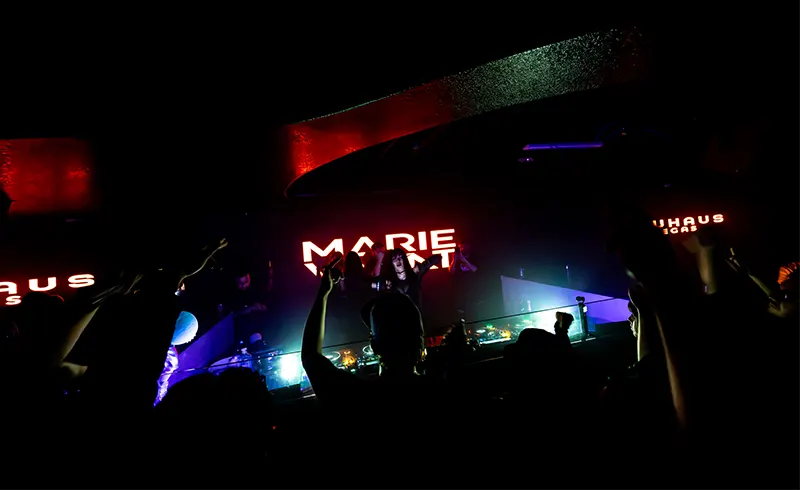
Bauhaus Vegas is where this history gets lived out in real time, every weekend, with local and international DJs who know exactly how to use every tool in the box.

The music leads. Come find out why.
Facebook
Twitter
LinkedIn
WhatsApp

Frequently asked questions

What is the history of DJ technology?
DJ technology evolved from vinyl turntables in the 1970s through CDJs in the 1990s, into digital software and controllers in the 2000s, and now includes AI tools and stem separation for real-time remixing.
The major turntables to CDJs shift happened in the mid-to-late 1990s, with Pioneer’s CDJ-1000 (2001) cementing CDJs as the global club standard.
Yes. Many techno and house DJs still use vinyl, either exclusively or alongside digital setups. It remains a respected format in underground music culture.
A Digital Vinyl System (DVS) uses time-coded records to control digital music files through real turntables, combining the feel of vinyl with the flexibility of digital libraries.
Yes. Bauhaus Vegas hosts curated DJ sets every weekend, featuring both local talent and internationally recognized electronic music artists.
Stem DJing allows real-time separation of a track’s elements, drums, bass, vocals, and synths, giving DJs the ability to remix live on the fly during a set.